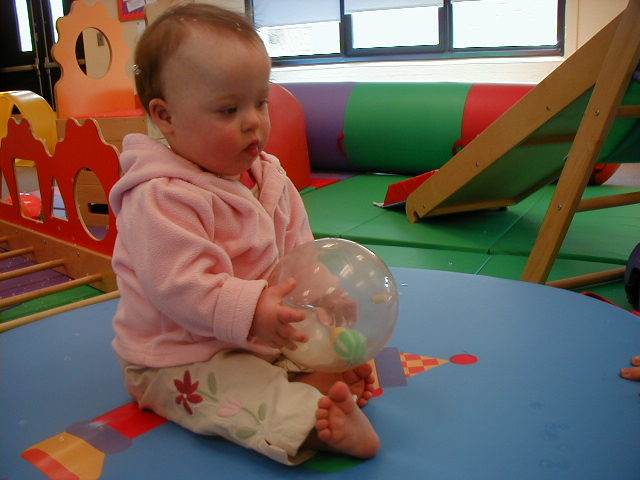
Individuals with Down Syndrome tend to have low muscle tone around the mouth. Tongue protrusion and speech difficulties are a result of this low muscle tone. It is important to stimulate and wake up these fine muscles. We did a lot of oral motor exercises with Alex since she was a few months old. Alex has pretty good "lip closure" and has several audible words at 2. so so important for speech....work on lip closure, not letting the tongue hang out!...but make it fun!
some suggestions:
- tapping around the lips
- deep pressure on lips
- massage the mouth
- Nuk brush in mouth
- brush tongue
- blowing a feather or cotton ball
- sucking through a straw
- blowing through a straw
- blowing bubbles in the bath
- whistles and horns
- kazoo, harmonica, recorder
- Fish tank tubing to blow into a
cup with sudsy water...eventually
use longer tubing to enhance
breath control and lip closure.
- making faces in a mirror
- blow feather or cotton ball
with a straw.
Alex was sitting up by herself by 8 months, crawled by 10 months, took her first steps at 15 months, was completely walking by 18 months. At 2 years old, she runs, and jumps. She has about 20 functional words. Her receptive skills are great as she can identify most objects, flash cards, body parts, animals, etc. Her memory is excellent. She has always been incredibly bright, alert, social, happy, outgoing, and healthy. Early Intervention, a home exercise program devised by Dr. Unruh, music therapy, gymboree, swimming, and a big busy family have all contributed to Alex's development.
When Alex was 2 months old, we met with Dr. John Unruh, PhD. from The Center For Neurological Rehabilitation. (now retired) Dr. Unruh meet with families and children with special needs from all over the US and abroad. He has worked with individuals with Down Syndrome for 40 years. He evaluates each person's neurological development and designs and teaches an individualized treatment plan to be carried out at home. We do a sequence of sensory-motor exercises with Alex two to three times a day. The program is a combination of gross, fine and oral motor exercises as well as various sensory exercises to strengthen each area and help build a healthy, more organized nervous system. Alex enjoys the routine; it is fun. It is also a great bonding time for us. Dr. Unruh evaluates Alex every 4 months and a new exercise plan is devised. He also oversees Alex's total development to direct us to the appropriate specialist when needed. This program is an integral part of Alex's development. Doctor Unruh has also empowered us and given us such a clear and positive direction. . (Update - Dr. Unruh is retired.)
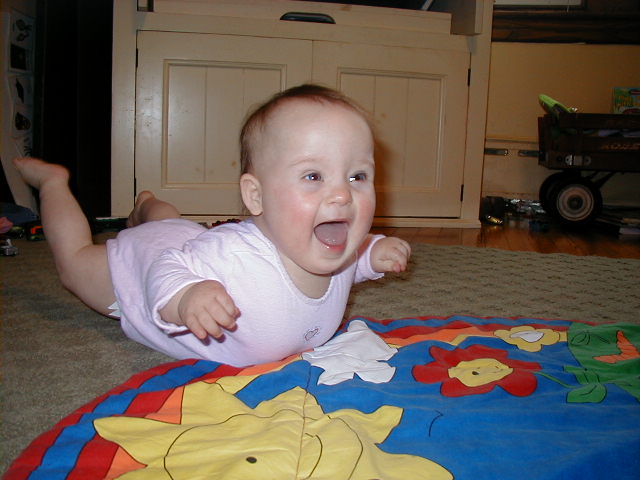
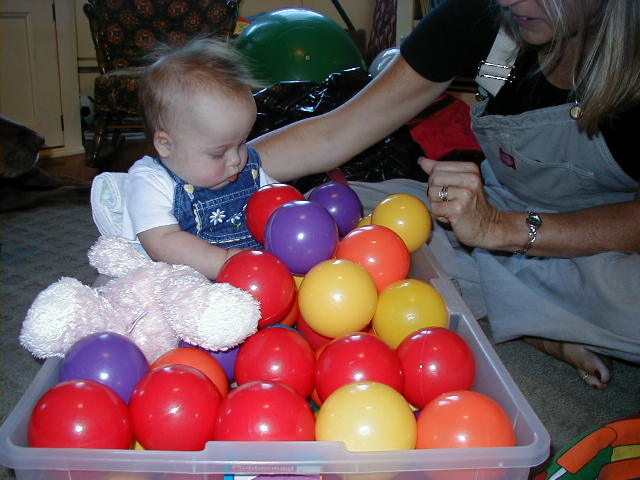
"Sky Diving" 7 Months Old
6 months Old... Playing With Early InterventionTeacher
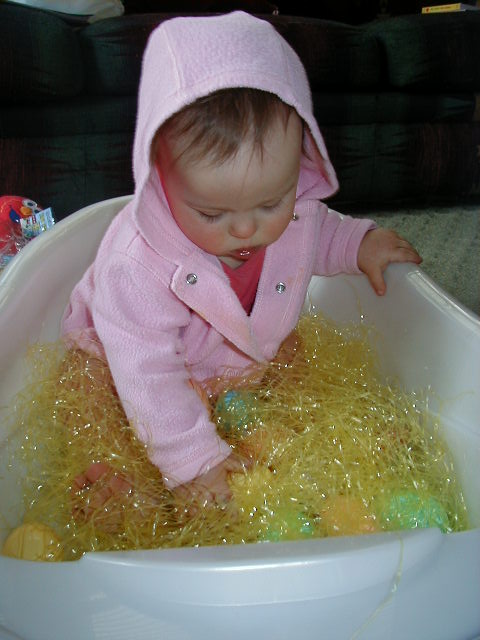
11 months... Easter Egg Hunt?
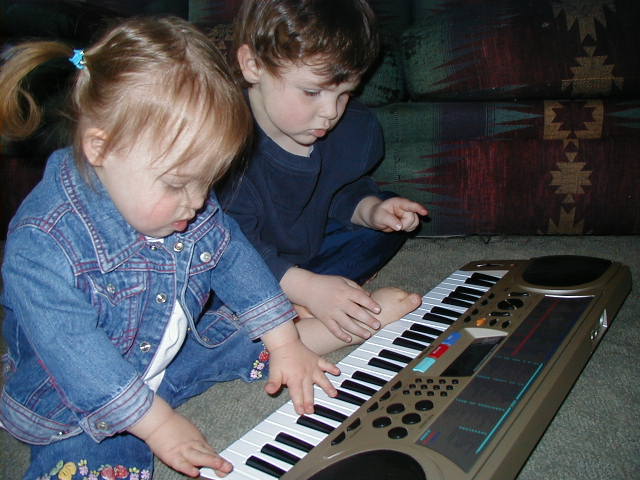
Alex - 24 months old, Sam - 3 1/2
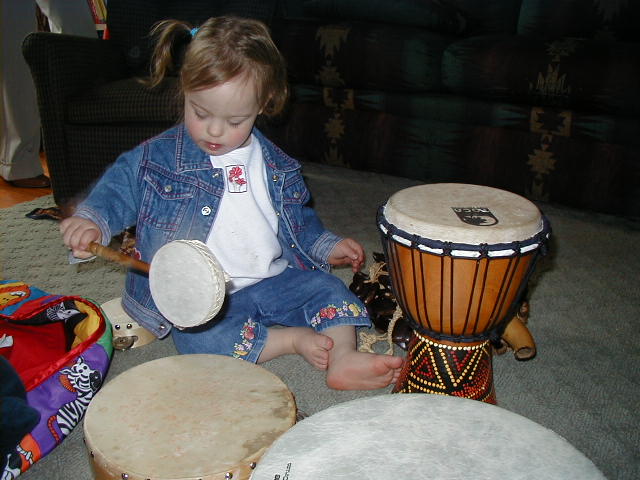
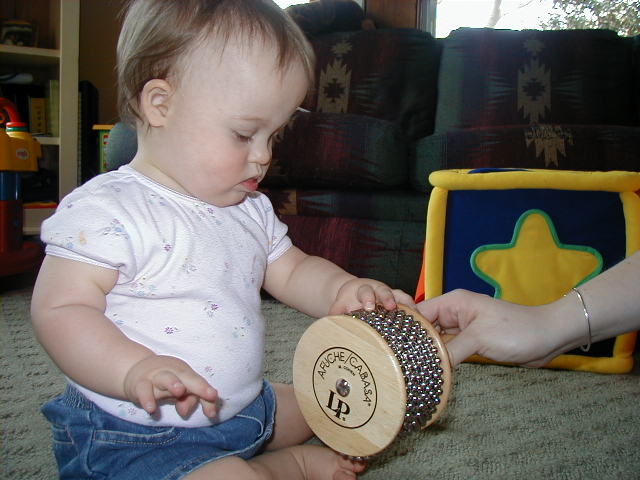
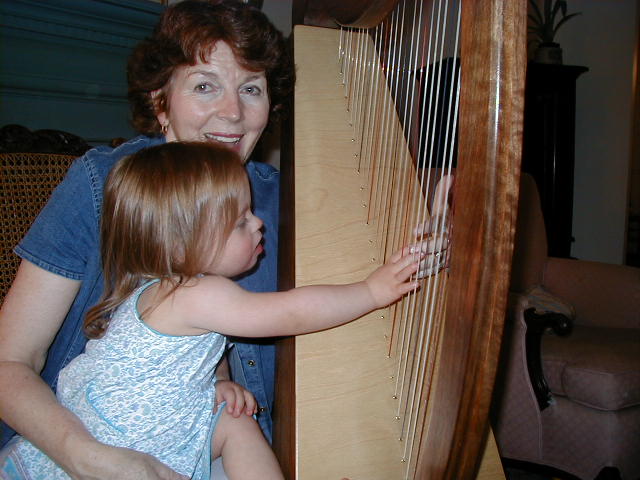
Music has such a positive impact on the brain's development. We always have a lot of instruments around the house and music playing. We found a music therapist to come to our home once a week to give Alex and Sam more exposure to music. She introduced Alex and Sam to a variety of instruments. The music therapy, besides being a lot of fun, has helped with fine motor skills, listening, attention, sharing, turn taking, memory, concentration and so much more.
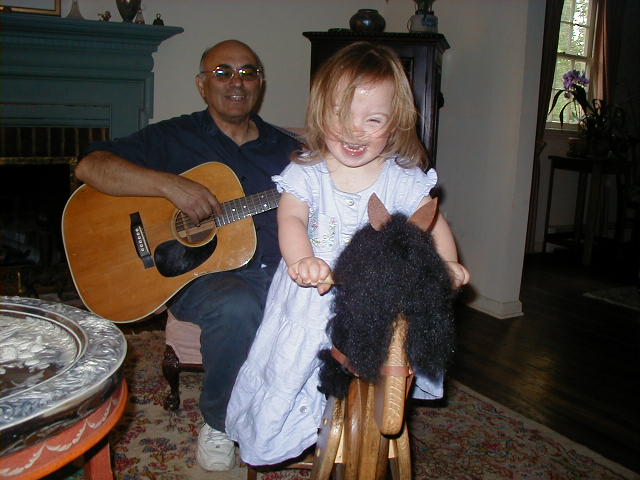
Alex comes from a musical family. She especially loves listening to Pop Pop play the guitar! "She goes on the prowl each night like an Alley Cat...Meow!"
Children with Down Syndrome face a variety of developmental challenges. Low muscle tone is common and affects gross and fine motor skills. Low muscle tone can also affect speech as there are many fine muscles around the cheeks, lips and tongue needed for clear speech. Auditory and visual problems are also common. Some children exhibit other sensory problems that resemble autism. The brain experiences very rapid growth in the first few years of life which is why early intervention is so important. Alex worked with a physical therapist and a teacher one hour a week from 2 months old to help build her gross, fine and oral motor skills as well as her cognitive and social skills. She started music therapy once a week around 9 months old and speech therapy once a week around 1 year old. Alex is also involved in Gymboree and swimming. We always provide her with a lot of sensory input (books, flashcards, massage, music) which she responds to postitvely.
National Association for Child Development Developmentalists travel to various cities, meet with clients, and after evaluating their neurological development, write an individualized neuro-educational program. This site has numerous articles explaining various aspects of the neurodevelopmental philosophy.
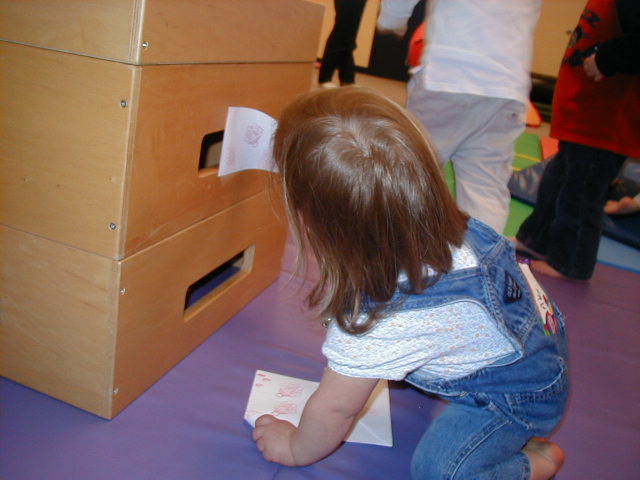
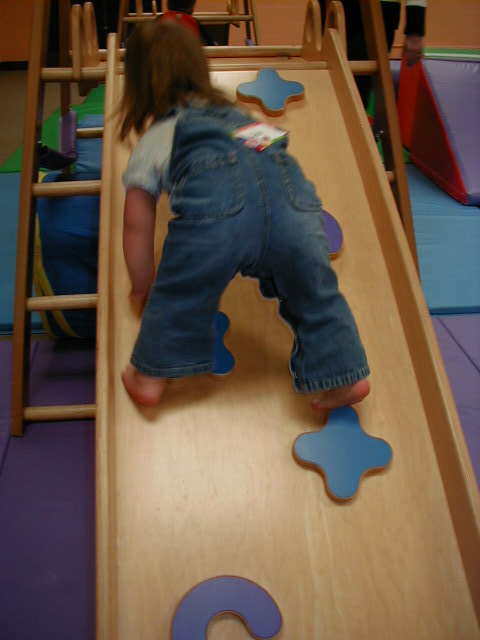
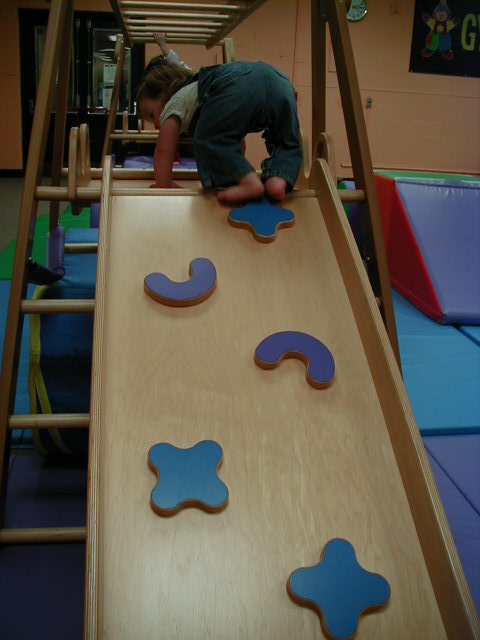
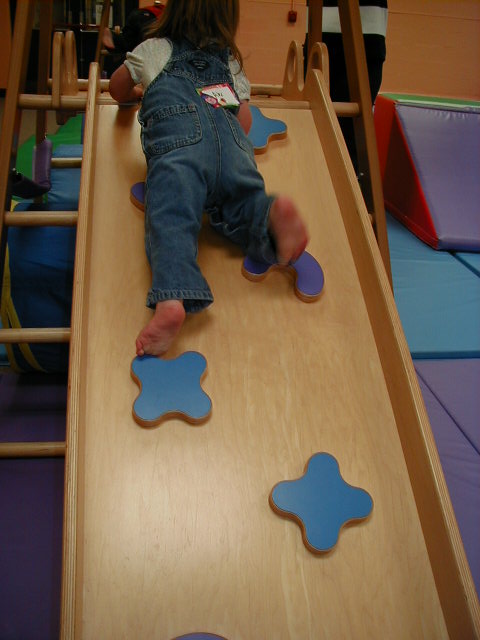
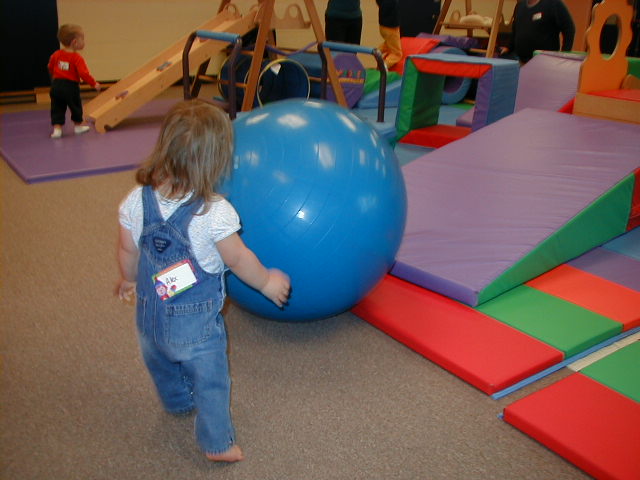
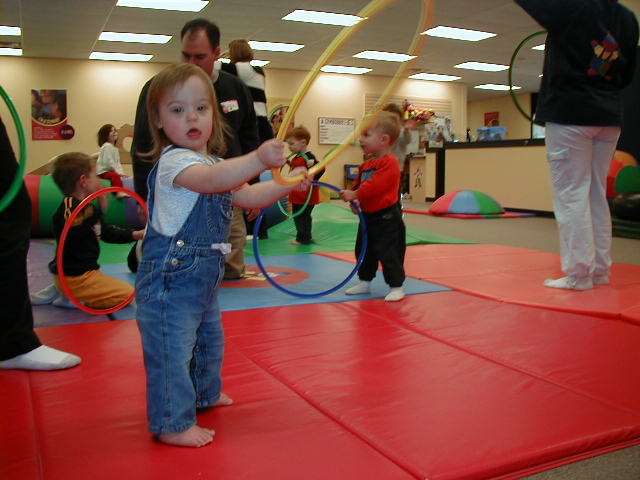
Alex loves Gymboree. Click on each picture to enlarge. Alex is 10 months old in the first picture. She was 20 months old when the other ones were taken.
20 months old
Some examples of sensory exercises we did with Alex from about 0-3 yrs.
1. Patterned crawling...moved her legs and feet in a specific sequence to simulate and stimulate crawling.
2. Showed her fluorescent colored pictures in a dark room under a black light.
3. Ticked her hand for 30 seconds with a soft brush then gave her an object to hold..always changing the object and textures. Then change hands.
4. Used a massager all over body.
5. quick deep pressure ariound lips with pinching fingers.
6. Whispering conversation in ears.
7. Walking up and down the length of a ladder on the floor in between the rungs.
8. Viewing sight words flash cards by age 2. ( maybe 3-5 new words a week, then adding to the pile)
Alex's brother, Sam has always been involved in Alex's therapy and activities. Sam has been such a great motivator for Alex.
* The exercise program we do with Alex is a specific sequence of activities. Each sensory-motor exercise is about 1-2 minutes long. There are usually 10-15 exercises, for a total program lasting about 30 minutes 2 times a day. We meet with the doctor every 4 months and a new exercise plan is developed. The exercises are individualized and tailored for each person. There are many variations to the exercises above, for instance, when Alex was a baby, we tickled her hands with a soft makeup brush, after 4 months, we rubbed her hands with a rough towel, then 4 months later, we rubbed with a nail bristle brush. Alex always loves to do her exercises and knows the routine; we make it fun. It is such positive one on one time with her.
-To assist adults and children with individualized programs that will enable them to come closer to reaching their full potential."
Studies confirm that sign language is a excellent and effective tool to help children with delayed speech communicate their needs. It also strengthens and develops the communication areas of the brain. Sign language is easy and encourages communication skills even if your child is not verbal yet. Alex picked up on signs very easily. I think basic signs should be started around 1.
As part of Dr. Unruh's program, we started showing Alex sight words by age 2. Now at age 4, her visual memory is strong and she can read about 50 sight words. We were not as consistent with the reading program, and I believe she could read so many more words if we did it more often. We used large index cards with words written in thick black marker. We started with familiar words (Mom, Dad, Alex, Sam, cat, dog...) and showed them to her several times a day just showing her the card and reading the word to her. We just showed her the words...did not test her until she could start saying the words around 4 years old. Every week we would make a few more word cards to add to her pile. She just turned 5 and can read about 100 words. *Now she is in Kindergarten (5 1/2) and can read even more words and even some books!
Sign Language
Reading
Potty Training
Alex was completely potty trained during the day by age 3 and dry at night by age 4. We started her sitting on the potty around 2. We rewarded her with lots of praise when she went. In the beginning, we rewarded her with a small candy like a smartie when she went, then the praise was good enough for her and we stopped the candy. We kept lots of books in the bathroom which she loved to look through. I think the key is to make it normal, not too big of a deal, but certainly give encouraging praise.